
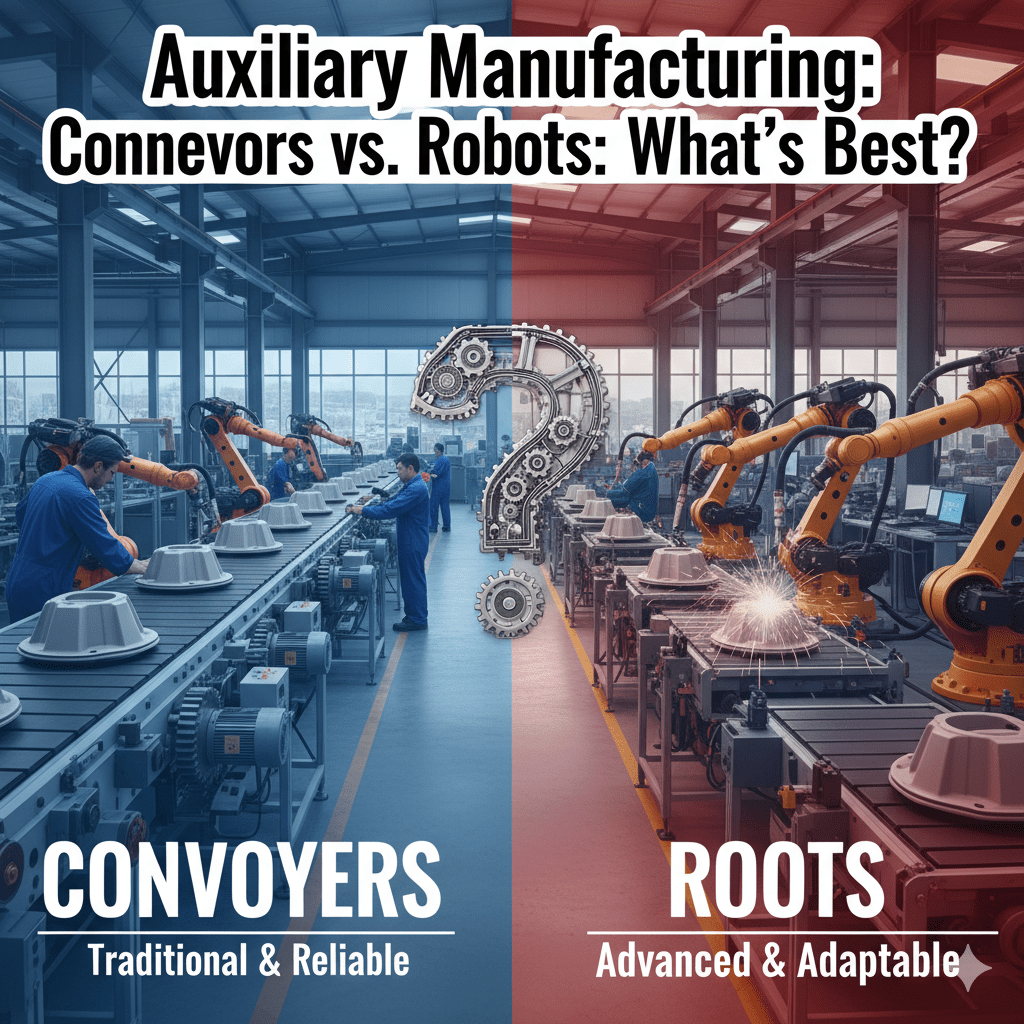
If you need better factory support, robots and conveyors can perform the work, changing your cost structures and ROI. We will discuss what auxiliary manufacturing is, examining both systems with all their advantages and disadvantages so you can decide your best automation fit.
When Do Conveyors Beat Robots?
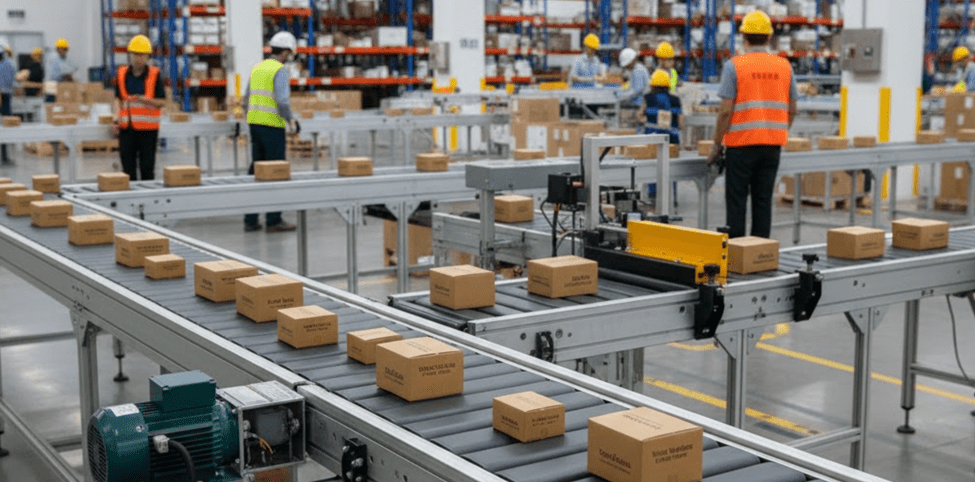
Conveyors are often cheaper and faster than robots for basic tasks, making them a top choice in auxiliary manufacturing. For the simple problem of moving something a long distance, conveyors can reliably achieve around 1,000 items in a straight line every hour. These systems are powered by very simple components, usually just a drive motor and a PVC belt.
The same simplicity holds true when moving textile auxiliaries. Robots are clearly overkill in this specific case. If your task is highly repetitive, a conveyor is almost always the best choice because they are very economical in CAPEX. Furthermore, their sorting capability is incredibly reliable, operating 24/7 without issues.
Defining The Auxiliary Manufacturing Role!
Let’s explore what auxiliary manufacturing truly is. All these essential systems are designed specifically to help the main production line of your plant. Have you ever stopped to think about how many of these support systems keep your own facility running?
Support Systems
Support systems are absolutely crucial, as this is the definition of a primary auxiliary process definition. These systems ensure the primary machines are functioning properly, so you should consider items like pumps, fans, or compressors. Simple tools, such as a 2 HP motor, keep production flowing smoothly. While they do not primarily produce a product, they offer valuable assistance. Having adequate systems in place ensures you will not experience operational delays.
Material Handling
Material Handling describes the process of moving items, which includes raw goods as well as finished parts. A textile auxiliary chemicals manufacturer does this on a daily basis. In this specific case, we might be moving heavy drums of silicone softeners. This task is often done by a combination of forklifts, AGVs, or hoists. Proper handling is always aimed at reducing product damage and increasing efficiency on the production line, making it essential for a seamless operation.
Process Cooling
Process Cooling is simply defined as the removal of excess heat. Most heavy machines tend to heat up significantly during use. Common tools like chillers and cooling towers can help manage this. These tools are vital in maintaining equipment at a constant 20°C, which helps to prevent overheating. This cooling process also helps in maintaining the quality of the product and enhances the durability of the machines. Plastic molding is one common process that requires heating and subsequent cooling.
Optimize Performance
Your goal should always include optimizing your system performance. Effective auxiliary manufacturing systems allow your main line to work faster because they streamline the entire workflow. This ultimately means higher speed with reduced waste. You might very well include sensors and data trackers to monitor everything. For example, I’ve found that tracking OEE is always a good idea in my own facility. This practice augments your total output and can change a good line into a great line.
Packing Lines
Packing lines represent the last auxiliary step in the process. This system vertically deploys the goods and often includes case erectors, fillers, and tapers. With this automation, you can easily pack 500 boxes an hour, which automates tedious manual work. This also helps control order accuracy. Good packing is critical to product protection and final customer satisfaction.
| Auxiliary System | Key Function | Primary Role | Examples | Technical Parameters | Application |
| Support Systems | Functional Support | Ensure machines function | Pumps, fans, compressors | 2 HP motor | General production |
| Material Handling | Logistics | Moving items | Forklifts, AGVs, hoists | Silicone softener drums | Textile chemicals |
| Process Cooling | Temperature Control | Removal of excess heat | Chillers, cooling towers | Constant 20°C | Plastic molding |
| Optimize Performance | Efficiency | Streamline workflow | Sensors, data trackers | Tracking OEE | Main production line |
| Packing Lines | Finishing | Prepares goods for shipping | Case erectors, fillers, tapers | 500 boxes/hour | Shipping |
Overview of Auxiliary Manufacturing Systems!
Analyzing Conveyor System Strengths!
Conveyor systems clearly have many strengths. Let’s analyze the specific factors that make them so reliable for auxiliary manufacturing.
Belt Conveyors
Belt conveyors are extremely common in the industry. An auxiliary machine manufacturer will always have first-hand belt experience. A belt conveyor is a machine that uses a long, continuous PVC or rubber belt. A drive pulley simply spins the belt, making them great for the transportation of light boxes. They are used extensively in food processing because they do not cost a lot and work very well. They represent a basic but highly efficient answer to a movement problem.
Roller Conveyors
Roller conveyors feature metal tubes as the main structure, along with rotating rollers. These rotating rollers help in moving products to the desired location as they fulfill primary functions of the system. Reputable auxiliary equipment manufacturers ensure strong construction. Rollers can be part of a gravity-fed system or can be powered. Each powered roller is often equipped with a 0.5 HP electric motor, which helps in the easy movement of bulky items. These bulky items can include large totes as well as pallets. These items can be withstood because powered rollers are very strong and sturdy, giving them a long shelf life and making them very durable.
High Efficiency
High-efficiency conveyors possess a very high-efficiency feature. They are capable of shifting goods and services without any rests for breaks, 24/7. This provides a continuous flow operation which makes the outcome predictable and steady. A conveyor belt helps in moving parts at 60 feet per minute, which is considered a normal speed that helps in avoiding factory bottlenecks. At the same time, very low energy is consumed, which is excellent for factory budgets.
Low Maintenance
Having low maintenance requirements means the system uses very strong and simple parts. A motor and a belt just need to be inspected periodically. The system has very few complex electronics, which means that there is little to no downtime. Maintenance is easy, as only a simple check is needed every 3 months. In other words, repairs are quick, which makes the system reliable and saves a lot of stress. As the Society of Manufacturing Engineers (SME) notes, “For simple, linear part transfer, the reliability of a conveyor system is virtually unmatched, offering uptimes well over 99%.”
Modular Systems
Conveyors are commonly modular systems. You can maneuver the layout without any trouble. You can simply add a curve, a spur, or a lift gate. This modularity enables you to grow. You can keep the remainder of the line and only have to add the additional 10-foot segment. This is highly beneficial for your future requirements because it is adaptable and easy to implement.
Robot Strengths In Auxiliary Manufacturing!
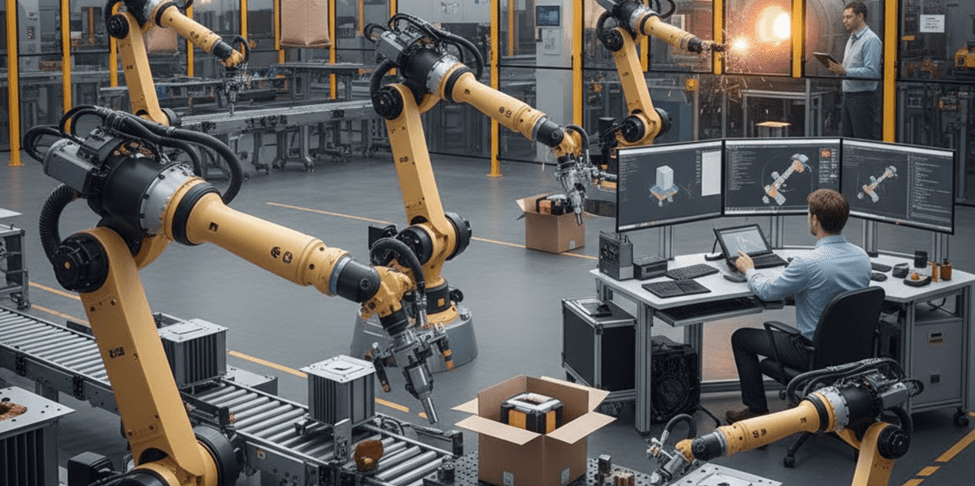
Robots also have individual strengths in auxiliary manufacturing. They add a great deal of flexibility in the plant.
6-Axis Robots
A 6-axis robot is incredibly flexible, as it can perform the movements of a human arm. This design is intricate, especially in contrast to simple APUs. Suppliers of auxiliary power unit manufacturers also require a certain level of accuracy. The robot can twist, turn, and reach, allowing it to grasp objects from any position. This capability is very helpful for intricate activities.
High Versatility
Robots also have high versatility, which is the ability to perform many different functions. Auxiliary transformer manufacturers often require tools that are adaptable. A single robot can perform welding, painting, and packing processes alternatively. This is accomplished without any changes to the end-of-arm tool (EOAT). This is advantageous for production systems that have low volume but a high variety of products. Many fixed machines can be simplified to just one robot.
Complex Assembly
Combining various robots with assembly stations allows complex setups with complex assemblies to occur. While performing small tasks, they need to be very careful. They need to be able to place a small 1mm microchip precisely. This work is very difficult for people to do consistently. A SCARA robot is very fast at doing this. SCARA robots also make sure that each assembly is identical to the last one, which enhances your quality control. These robots are great for the electronics and medical device industry.
CAD Programming
Instructions for mobile robots can be set in advance because they work with 3D CAD programs. This allows an engineer to draw the robot’s action path on a computer. This is particularly useful because it minimizes setup time on the work floor. Of the 500 lines of code, you can run a debug on just a portion. This way, you can see in the simulation if the motions are safe to perform. When everything is set, the program is transferred to the robot. This is much quicker compared to the process of manual teaching.
Reduces Injury
Because robots can perform some tasks, there can be less worker injury. There are many dull, dirty, and dangerous tasks that robots can perform instead of people. Think of lifting a 50kg bag or being close to hot furnaces. This protects your people from harm. This can also lower the number of RSI claims. Workers are then able to perform other safer and more complex tasks instead. This greatly improves your safety culture at work.
ROI Factors In Auxiliary Manufacturing!
How do you get your money back? Let us examine the ROI factors in auxiliary manufacturing.
- Labor Reduction: Robots automatically lower the labor costs. One auxiliary lens manufacturer I spoke with can attest to this. One robot can replace three workers on a line.
- Increased Output: Automation boosts the level of your output. One China auxiliary equipment manufacturer confirmed this recently. You can produce a larger volume of product every hour.
- Quality Improvement: You can improve product quality by reducing the defects to zero. This makes rework and scrap material obsolete.
- Waste Reduction: Systems which are effective reduce waste. This includes both material and energy. For instance, less silicone oil might be used in a lower quantity.
- 24/7 Uptime: Advanced machines have almost no downtime. They do not require breaks or sleep. So, this provides an optimal return on your investment.
Integrating Your Auxiliary Manufacturing Systems!
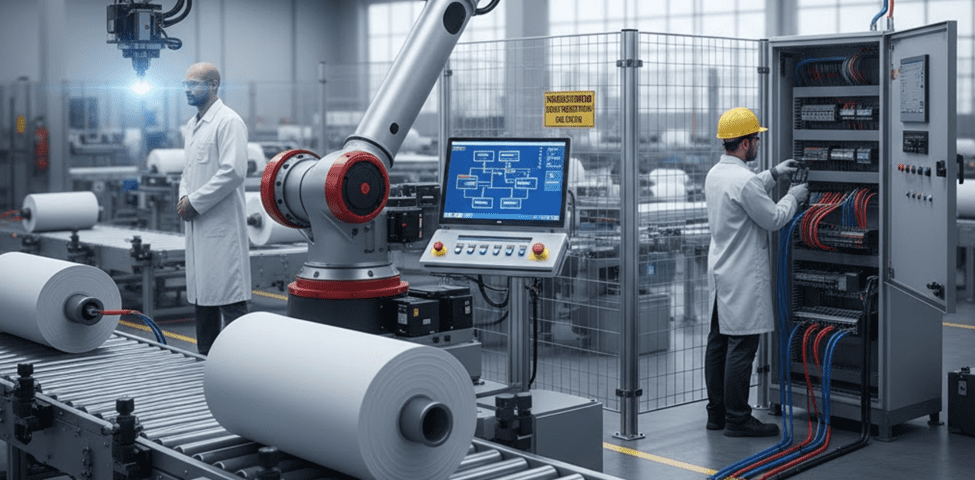
How do you join these systems together? This is an important step towards achieving your auxiliary manufacturing goal.
Assess Workflow
Every workflow should be simplified as much as possible for every step. A textile auxiliaries manufacturer, like Sylicglobal, makes “flow” mapping very simple. They concentrate on the steps that definitely slow progress down. Where is the work getting stuck? This information about cycle times offers clear opportunities for automation. Do not automate a suboptimal workflow; you must improve it first.
PLC Controls
Most guideline automation is controlled using PLCs. A PLC is also known as a Programmable Logic Controller. These are often used in textile auxiliaries manufacturers in China. They are the control “centers” in the system. The PLC determines the timing when the robot and conveyor should be activated using input and output signals. A quality programmable logic controller ensures the entire system works in harmony and avoids crashes.
Ensure Compatibility
Will there be clear communication? Will the robot be able to talk to the conveyor? It is important to see if there is a common communication protocol like EtherNet/IP or PROFINET. If the systems do not interlink, it is an information-less challenge. You must do this verification before the purchase. This is critical, and your integrator should also guarantee it to avoid frustrations in the future.
Installation Process
The installation process takes a few steps. First, the hardware needs to be secured. Next, all the wires assigned to the machine must be connected. Final checks include the 480V power. The longest step is always testing. In my experience, during the initial testing phase, the PLC code system needs to be modified repeatedly. Downtime can be great due to these tests. It is wise to assume the tests can take 2-3 weeks.
Safety Protocols
Safety measures must be taken at all times. Many robots can pose great harm to workers. The safety fencing must be completed. Before any extra measures are taken to the robot, a person must be a safe distance from the Maximum Zone Protection. According to the ISO 10218 standard, “A safe distance shall be maintained from the restricted space of an industrial robot.” The guidelines in ISO 10218 must be completed. This ensures the safety of all workers. Above all, safety is the priority.
FAQs!
People often ask about the auxiliary topic. Below are responses to some of the most asked questions.
What Are Auxiliary Hydraulics?
Auxiliary hydraulics provide additional power. It is a standard system often found on skid steers. It can deliver around 20 GPM of hydraulic flow, which means it only powers some attachments. This is different from textile auxiliaries manufacturing. These attachments may consist of a hammer, auger, or any tool of the like. This allows a single machine to perform a variety of functions. In construction, this adds great value to the machine.
What Is An Auxiliary Battery?
Auxiliary batteries are simply the secondary batteries. You can find them in trucks or RVs. This is not the concern of a textile auxiliary manufacturer. It powers the additional appliances. These are the fridges, lights, inverters, and the like. It is usually a 100Ah deep-cycle design. This maintains the charge of the main engine battery so that you can start the vehicle at any time.
What Are Auxiliary Materials?
Auxiliary materials are the components that are secondary to the main product. They are not part of the finished product. These are items like lubricants, coolants, or mold release agents. These auxiliaries are a necessity to the production. For instance, silicone oils are used in textile finishing. They make the process possible to use. These materials are consumed during production and form an important part of OPEX.
What Is An Auxiliary Boiler?
An auxiliary boiler gives additional steam. Every plant has a main boiler. If that boiler fails, the auxiliary boiler starts. It is often smaller, perhaps 150 HP. It can also fulfill the secondary steam requirements. This ensures the plant keeps running. This part single-handedly ensures the plant does not stop. This is an important aspect of risk management.
What Are Pharmaceutical Auxiliary Machines?
These are not the main tablet press; they are used to support the drug production process. Auxiliary machines include coaters, sanders, granulators, mixers, and so on. Blister packing machines are also very important. These machines are used to complete the tasks that relieve the user’s workload. They also ensure that the perfect dose of 10mg is dispensed. In cGMP Rule, they are very expensive and must be followed to the letter.
Conclusion
Robots provide high flexibility, while conveyors significantly reduce your CAPEX spending for auxiliary manufacturing. Connecting systems requires planning, and safety is a priority. We support your goals with qualified help for auxiliary systems. Contact Sylicglobal for expert support. You can also find great support from the best site called HanuSEO.